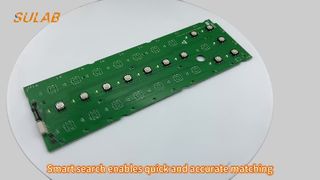
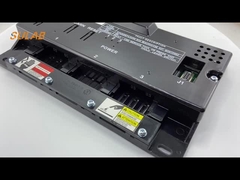
Brief: Need quick answers about practical use? This video highlights the essentials. Watch our demonstration of the UCMP Board V1.2, where we showcase its real-time monitoring capabilities, rapid safety response mechanisms, and how it integrates with elevator control systems to provide enhanced protection against unintended car movement.
Related Product Features:
Real-time monitoring of door zone signals, door lock status, and car position/speed for comprehensive safety logic.
Continuous diagnosis of brake status and drive system output to identify abnormal torque or displacement risks.
Millisecond-level protection response that cuts drive power and activates brakes when safety thresholds are exceeded.
Outputs fault codes and locks the system, requiring professional reset to prevent accidental operation resumption.
Redundant safety design with dual-channel signal comparison and dual power supply for enhanced reliability.
Compatible with functions like early door opening and re-leveling to improve efficiency while maintaining safety.
Mandatory compliance configuration for new and renovated elevators, compatible with mainstream control systems.
Supports self-test and testing modes for easy verification of functional effectiveness by maintenance personnel.
FAQs:
What is the primary function of the UCMP Board V1.2?
The UCMP Board V1.2 provides protection against unintended car movement by monitoring door zone signals, door lock status, and car position/speed, and triggering immediate safety responses like cutting drive power and activating brakes when thresholds are exceeded.
Is this board compatible with existing elevator control systems?
Yes, the UCMP Board V1.2 is designed to be compatible with mainstream elevator control systems such as Monarch and Siasun, making it suitable for both new installations and renovations.
What happens when the UCMP Board V1.2 detects a safety violation?
Upon detecting a safety violation, such as the car moving beyond the allowable displacement or speed threshold with doors open, the board immediately cuts drive power, activates the main and auxiliary brakes, outputs a fault code, and locks the system until a professional reset is performed.
How does the redundant safety design enhance reliability?
The redundant safety design includes dual-channel signal comparison and dual power supply, which operate independently of the main control board to reduce the risk of failure due to a single point of fault, ensuring continuous protection.